

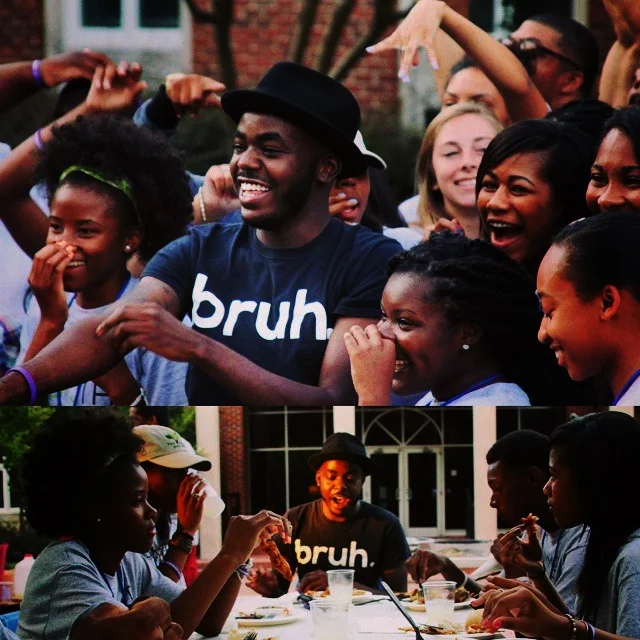
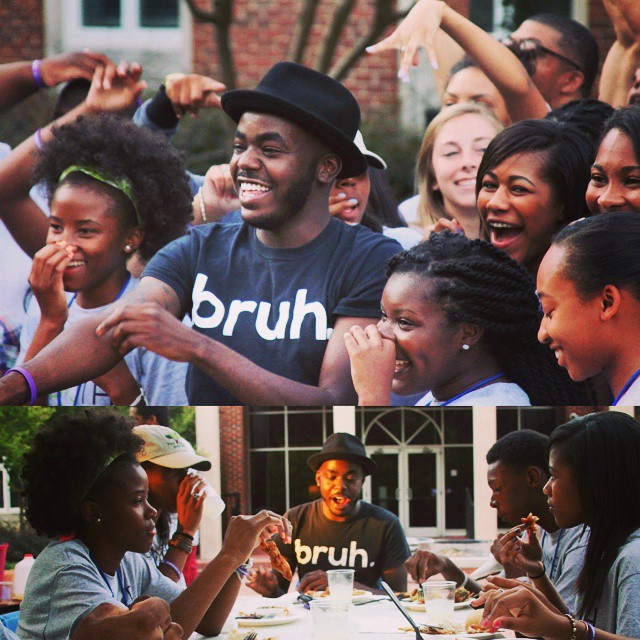
A Movement of Youth: The Leaders of The Now & Future
In the spirit of "keeping it real", dreaming beyond your current conditions comes from a place of privilege. Having the mental space to dream and challenge the narrative given is a "middle-class sensibility." They (The system of white supremacy and capitalism) don't even want straight A students at your nearest private school to dream and think outside the box (be liberal), so why in the hell would they want some urban(nigger) kid from North Memphis to challenge the status quo?
"Growing up as a teen/ there's a lot i've seen/ between people with red beams and fighting over ya team," I wrote these lines at 15 years old, I was a student at East High School in the 10th grade. This was my reality, just how white supremacy planned it, generations prior. Every reality is based on one's perception, in the 10th grade I had double-vision-perception. Even though I grew up seeing/living/being around some terrible things, I still saw myself as greater than my environment. No, I didn't think I was better than anyone else (except in rapping, I'll kill you niggas in that), but, my youth wouldn't allow me to not dream my way out of disparity.
In the spirit of "keeping it real", dreaming beyond your current conditions comes from a place of privilege. Having the mental space to dream and challenge the narrative given is a "middle-class sensibility." They (The system of white supremacy and capitalism) don't even want straight A students at your nearest private school to dream and think outside the box (be liberal), so why in the hell would they want some urban(nigger) kid from North Memphis to challenge the status quo? You are not suppose to think differently, you are supposed to take what was given to you, even if it was nothing, and enjoy it. Well, even if you don't enjoy, just shut the fuck up about it. We (The system of White Supremacy and Capitalism) don't want to hear about your "excuses" for being poor and undereducated. If you weren't so lazy, then this wouldn't be happening to you.
*Que middle finger*
I had always had a dream, though that dream may have changed in my very early years, around 3rd grade, it stuck. I wanted to be a rapper. And not just some dude that says they rap and lives at home with his mom until he's 40, like a successful rapper. Even though everyone around me grew up listening to rap music, seeing black people become successful from their talents, and take over a global cultural society, not many people thought that "I" could do it. Again, my youth wouldn't allow my mind to be taken over by doubters and naysayers.
My youth, my youth, my youth is on fire! I don't need no water let that mutha fucka BURN!
Fast-forward to 2015, I am 22 years old, I'm a business owner, I'm happily married with 2 kids, and most important I am making my 3rd grade self proud, because I AM A RAPPER. My Rapper = Activist, Educator, Lecturer, City Planner, Mentor, Wordsmith, Politician, Husband, and Thinker. Take that 3rd grade self, I bet you didn't imagine all this.
On Wednesday, June 17th I made my way to The William Winter Institute for Racial Reconciliation in Oxford, Mississippi to deliver a lecture/Workshop titled: "Movement Soundtracks: Hip-Hop Storytelling and Social Empowerment, for their Summer Youth Institute. This is a topic that I spent my life learning. Hip-Hop storytelling is what saved my life, I have to spread the awareness of how great Hip-Hop can be.
“The William Winter Institute for Racial Reconciliation works in communities and classrooms, in Mississippi and beyond, to support a movement of racial equity and wholeness as a pathway to ending and transcending all division and discrimination based on difference.”
On June 17th, I walk into the Triplett Alumni Center on the University of Mississippi campus. I was nervous, not because I had never spoken in front of people before, but because teenagers can be RUTHLESS. I don't mean they will burn down your nearest CVS, I mean they will ask the real hard hitting questions that will keep you on your toes. Also, they are fucking judgmental. I look around the room and I notice something that really made my blood boil. Sitting in the exact same room that the workshop is going to take place, is a confederate flag, also known as the state flag of Mississippi.

So, after I got over seeing this symbol of racism in the same room that we are supposed to be having racial conciliation, we got to the nitty gritty. Those same teens that had me nervous, made me realize and remember how bright and on point the youth is. This group of students really touched me in a way that I will never forget. We talked about how backs are viewed in the media. We talked about Hip-Hop was started as a response to social and economic environments. We talked about the degradation of women in Hip-Hop, and the media at large. We talked, a long time. It was powerful.


On Saturday, June 27th I made my way back to The William Winter Institute for Racial Reconciliation in Oxford, Mississippi to deliver a lecture/Workshop titled: "Change the World Around You: Community Engagement Through Art & Technology." for their Summer Youth Institute.
This time I was talking to different group of teens, this group was called SYI 2.0. This was their second time being to the Summer Youth Institute, now they are a few years older and are wiser. This group is ready to actually take on the world with just a little guidance. We talked about ways that they can use their voices now, and never wait for an "achievement" to start doing something. In this generation we have social media, planes that can fly 700 miles per hour and carry 300 people at a time, there is no reason for us not to be connected to the world. We are in a global society, and to thrive within a global society we have to attack the problems that prevent us from being connected. We have to use our art to speak to issues like homophobia, sexism, racism, rape, inequality, justice, etc. Art can and will change the world, it has for generations. The people are afraid to speak up, are forgotten.
I'll let the young soldiers tell you what they got from this all.
Head to Instgram.com/kingofmarco to watch videos


We are the youth, we are the future, we are the now!

DreamChaser Chronicles #2: From Slaves to Leaders
"Two hundred years ago, two black men crossing the Kentucky boarder to Ohio were 99.9 times out of ten escaping slavery. Now in 2015, I’m crossing the same boarder with Dr. Earl Wright (a black man) heading to Cincinnati to deliver this work."
Dreamchaser Chronicles #2: From Slaves to Leaders:
March 11th, 2015 is another historic day for me. On this day, I made my way to the University of Cincinnati to do yet another lecture and performance for the UC Africana Studies program. I want to thank Dr. Earl Wright II (a fellow North Memphian) for bringing me out and giving me the platform to tell my story, and most importantly OUR story. Let me give you a little historical background of the place. The University of Cincinnati was founded in 1819. That’s 196 years ago. Guess what Earl and I would have been in 1819? A CEO? Maybe a Doctor, Maybe a just a regular tax paying citizen with the right to vote?–how about none of the above; a slave. I flashback to the moment when Earl and I were driving from his beautiful home in Northern Kentucky heading to the university, I thought about 1819, I thought about us being there in that time and how different it would have been for us just a short 196 years ago. This flash back moment led to me posting a status on Facebook that captures my feelings in few short characters, it read:
“Two hundred years ago, two black men crossing the Kentucky boarder to Ohio were 99.9 times out of ten escaping slavery. Now in 2015, I’m crossing the same boarder with Dr. Earl Wright II (a black man), heading to Cincinnati to deliver this work.”
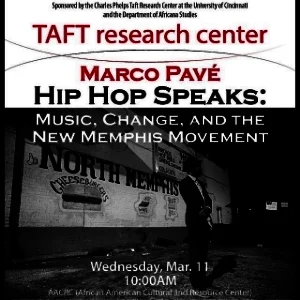
I hit the students with my soon to be classic talk, HipHop Speaks: Music, Change, and the New Memphis Movement. Black people have went through tremendous turmoil just to get to this point that we are now. Some may say, “Aw, that was 200 years ago, get over it, stop harboring on the past and the negative.” I don’t even have to go back 200 years (I do and I WILL because that’s our history) to show that white people in America at any moment in history tried to keep us down. The delivery of the work went through flawlessly.


I also broke it down to the students that it ain’t all political rap. I proved my point by dropping my single Cake. We are in a time and space that is critical for our culture. As an artist you have to represent multiple things and wear multiple hats. Artist are humans, not robots. I am providing the space that will allow us rappers to be viewed as intellectuals, musicians, historians, turn up gods, twerkers, etc. In the words of Andre 3000, “The South got something to say.”
I do this for Memphis, I do this for equality, I do this for America, I do this for Hip Hop, I do this for the ancestors, I do this legends who gave me advice, I do this for a living (I’m that nigga).
Apr 2, 2015
The role of music in activism.

After the shooting of Michael Brown this past August, social media has been a means of organizing protests and activism. For example, multitudes of demonstrators organized via social media using the hashtags #BlackLivesMatter, and #STLBlackFriday. The pictures captured of the huge groups of demonstrators playing dead are incredibly powerful and spread like wildfire on social media. Numerous other mass “die ins,” peaceful walks and marches, and thought provoking quotes can be found using these hashtags among others. Hashtags fuel the peaceful protest because they can help people organize, educate, and most importantly bring direct attention to major events and demonstrations. They are a way for people who are not present to remain informed, and involved, as they spur demonstrations in other areas. For example, the viral videos, Instagram images, and tweets from Saint Louis die-ins, spurred die-ins nationwide. There was even one at the National Civil Rights Museum here in Memphis.
The Brooks Museum of Memphis also wanted to know the role of music in activism historically and in todays landscape.
ELIZABETH MURPHY Marketing Associate @ Brooks Museum: What is your favorite protest song? Speak to the role of music in activism/change/protest today.
Marco Pavé Hip-Hop artist and CEO of Radio Rahim Music Associate:
I have a lot of favorite protest songs, I’d have to say my favorite is, “We Are the People Darker Than Blue” (1970) by Curtis Mayfield. It’s a great songspeaking against white supremacy and the ideas that white supremacy created within the black community. One of the lyrics says, “We people who are darker than blue/are we just going to stand around this town and let what others say come true?” He was protesting the images of black people put in the media by racist networks, movies, and magazines, as well as individuals from everyday whites to the highest governmental leadership. He was also looking at dynamics within the black community that come from white supremacy, protesting the idea that lighter skin is better. His argument was that even if you are lighter than me, you are still black to white supremacy: “High-yella gal, can’t you tell? You’re just the surface of our dark deep well.”
Speak to the role of music in activism/change/protest today:
Music is central to activism/change/protest today. Some people may disagree but they are most likely the ones that still watch MTV waiting on music videos to come on. The fact that we are still battling some of the same issues that artists like Curtis Mayfield, Roberta Flack, Marvin Gaye, Nina Simone, and Jimi Hendrix were battling is a big indication that music is still one of the only outlets that can spark change. “Mainstream” artists like Kendrick Lamar, J Cole, Kanye West, D’Angelo, Erykah Badu, Janelle Monáe, Beyoncé and Jay-Z just to name a few have silently built their careers on activism/change/protest. I say silently because it’s obviously not heard like the artist of old. J Cole, Kendrick Lamar, and Kanye West all have performed their own protest songs on live network TV stations like ABC, MTV, and NBC. J Cole performed “Be Free” (a response to the recent police shootings of blacks) on The Lateshow with David Letterman. Kendrick Lamar performed his single “I’ (a response to all the oppression and police brutality, he encourages us to love us even when “they” won’t) on SNL. Kanye West performed his single “New Slaves” (a response to constraints on Americans not being free, all Americans at that) on SNL. These are just a few examples of how music today is still central and complimentary to activism and social change. I myself have stepped into that playing field, sampling the great song by Curtis Mayfield “We Are the People Darker Than Blue” on my song “Black Tux,” which appears on my forthcoming EP, Perception. “Black Tux” uses the metaphor of a cheap black tux from Macy’s, as opposed to a high-end designer one made in Italy, to describe how America values and views black people. It also ties into how those views of us make it harder for blacks to love and support one another in families and communities. Also, just being, breathing, standing, or thinking is a form of resistance for black artists, given that we can be struck down in the street for much less and our violators are not punished. Even deliberately making a song about dancing in times like these are protest songs. People expect us all to be up in arms and in the streets having war, but when you can find peace and dance anyway, that’s protest, too.
NOTE: I say silently because it’s obviously not heard like the artist of old. I think what’s happening is that there is a bias inadvertently created by our idolization of that time of protest music that makes us unable to think of these artists as doing activism and protest music. To see their unapologetic blackness in the industry as protest, their daring to make songs about the black experience, one of the most devalued experiences in our country, as activist. The fact that many of these artists are very wealthy and are perceived as such also makes it difficult for people to hear them.